
Facial Cosmetic Surgery
Eyelid Surgery (Blepharoplasty)
Before and after photographs
See all resultsDirect Brow Lift & Upper Blepharoplasty
Upper Blepharoplasty
Upper Blepharoplasty
Lower Blepharoplasty
Eyelid Surgery (Blepharoplasty): Brighter Eyes, Brighter You!
Eyelid Surgery (Blepharoplasty)
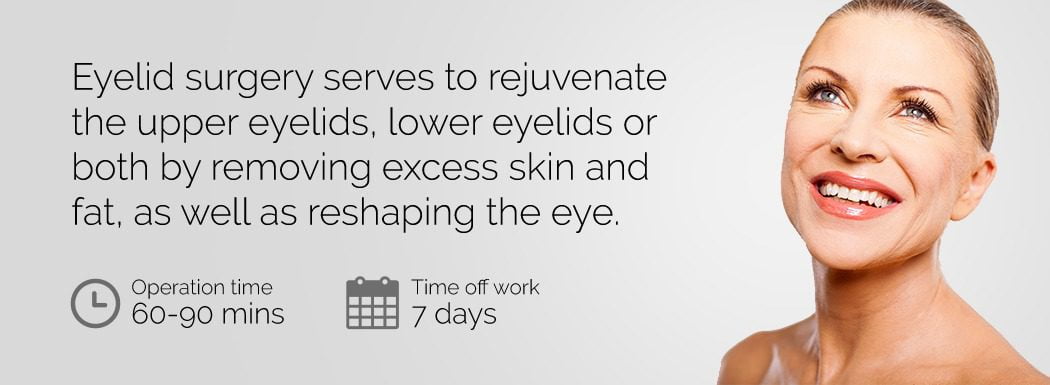
Eyelid surgery (blepharoplasty) serves to rejuvenate the upper eyelids, lower eyelids or both by removing excess skin and fat, as well as reshaping the eye.
A youthful eye typically has smooth, wrinkle-free skin on the upper and lower eyelids and absence of puffiness. However, with increasing age eyelid skin can become lax and wrinkled.
This combined with puffiness can give the eyes a tired look. The lax and sagging upper eyelid skin can also fold over the eyelashes causing ‘hooding’ and in severe cases compromise vision.
Eyelid surgery may be combined with brow lift or sub-brow fat grafting to completely rejuvenate the eyes.
What Does An Upper Blepharoplasty Not Do?
Upper blepharoplasty cannot raise the eyebrows or reduce the appearance of deep wrinkles, crow’s feet or dark circles under the eyes. These issues may be addressed with wrinkle-relaxing injections, laser resurfacing or other cosmetic treatments.
What Causes Puffy Lower Eyelids?
In the majority of cases, puffiness of lower eyelids is due to bulging of periorbital fat. In the lower eyelid there are 3 fat compartments that are held in place by a thin sheet of tissue called the orbital septum. As we age the orbital septum becomes thinner and less supportive, allowing the fat to bulge.
Lower blepharoplasty is suited for patients who develop puffiness of the lower eyelid. If there is significant ageing of the midface as well, lower blepharoplasty alone may not achieve the rejuvenating effect that is desired. For such patients a combination of lower blepharoplasty and midface lift is more suitable.
Upper eyelid surgery is performed under local anaesthetic and the incision is hidden in the natural eyelid crease. Postoperative discomfort is minimal and most patients can expect to return to normal activities after one week. Sutures are removed at one week and most patients can resume wearing makeup and contact lenses at that time.
Lower eyelid surgery is performed under local or general anaesthetic and the incision is placed just under the eyelashes. Through this incision prolapsed fat can be removed or re-draped. If required, a midface lift can also be performed at the same time to address midface descent. Excess skin of the lower eyelid is then trimmed and the incision closed with fine sutures.
If the lower eyelid does not have excess skin, Mr Karri may perform a transconjunctival blepharoplasty. With this approach the incision is made inside the lower eyelid to remove the bulging fat, leaving no visible scars.
The ideal patient for eyelid surgery is one who has healthy eyes with no serious conditions, does not smoke, does not have any medical condition that can hinder healing and has realistic expectations of the outcome of surgery.
Prior to your surgery, Mr Karri and his team will give you detailed aftercare instructions. This will include how to care for the surgical site and incisions, pain relief that may be used to handle discomfort and when you may resume normal activity.
Recovery From Eyelid Surgery
Swelling, bruising and a sense of tightness in the eyelids are common after eyelid surgery. These usually resolve within 2-4 weeks. In some patients the eyes can be slightly irritated and sensitive to light for a short time. You may wish to buy lubricating eyedrops to ease any discomfort. You should see the results of your eyelid surgery usually after two months.
View before and after photos of upper eyelid surgery
View before and after photos of lower eyelid surgery
Although eyelid surgery is a relatively straightforward procedure, it carries risks inherent to any surgical procedure. These risks include:
- Noticeable scarring
- Slight asymmetry in the appearance of the eyes
- Temporary blurred or double vision
- Haematoma (collection of blood beneath the skin), which typically resolves within a few weeks
- Dry eyes
- Overcorrection (removing too much skin) / undercorrection (not removing enough of the excess skin)
- Numbness of the eyelids
In rare cases, more serious complications can arise from eyelid surgery, such as:
- Infection
- Excessive bleeding and formation of a haematoma
- Drooping of the lower eyelid away from the eye (known as ectropion)
- Injury to the muscles surrounding the eyes
- Blindness
- Vision loss from retrobulbar haemorrhage (very rare)
- Allergic reaction to the anaesthesia
During your consultation, Mr Karri will thoroughly discuss these potential risks and side effects with you. The purpose of this comprehensive discussion is to provide you with the necessary information to make an informed and safe decision.
Medically reviewed by
Mr Vasu Karri
BSc(Hons), MBBS, MRCS, MSc, FRCS(Plast)
Consultant Plastic Surgeon
Last updated 27th September 2026
Related Procedures
Facelift
Facelift eliminates loose and sagging skin on your face and neck, creating a tighter and more youthful appearance.
Phenol Peel
A phenol skin peel revitalizes your skin by addressing fine lines, wrinkles and uneven texture.
Necklift
Necklift (platsymaplasty) is a surgical procedure that restores the youthful appearance of the neck.
What happens next
- 1
Send an enquiry
Use the form below or call. Kinvara Private Hospital replies to arrange a time.
- 2
Consultation with Mr Karri
At Kinvara Private Hospital, Rotherham. Examination, options and a written quote.
- 3
Your surgery
Booked at a date that suits you, with follow-up appointments included.
Interested in Eyelid Surgery (Blepharoplasty)?
Send an enquiry below and Kinvara Private Hospital will get back to you.