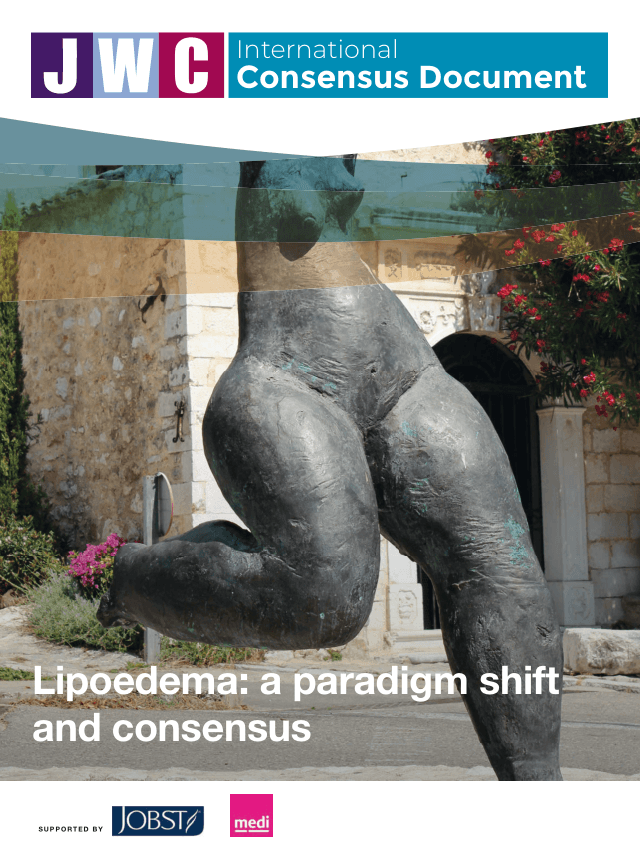
Lipoedema: a paradigm shift and consensus
Tobias Bertsch and Gabriele Erbacher (Földi Clinic, Germany), Rebecca Elwell (University Hospitals of North Midlands NHS Trust). Foreword by Professor Hugo Partsch.
Journal of Wound Care, Vol 29, Supplement 2, November 2020 · 52 pages
10 key takeaways
- An international consensus on lipoedema, supported by specialists from ten European countries.
- Diagnosis needs two things together: a disproportionate build-up of fat in the legs (sometimes the arms) and symptoms in that tissue such as pain, heaviness or tenderness.
- Despite the name, the authors found no fluid build-up (oedema) in lipoedema on examination, ultrasound or MRI.
- Manual lymphatic drainage is not considered a treatment for lipoedema itself; if used for pain, it should be limited to about a month.
- Between 80% and 88% of women seen with lipoedema in specialist centres are also living with obesity, and weight gain tends to make symptoms worse.
- The authors found no evidence that lipoedema progresses on its own: in their patients, legs stayed stable over many years when weight stayed stable.
- Sustained weight loss, including after bariatric surgery, reduced leg volume and eased symptoms, in some women to the point of remission.
- Pain is thought to come from low-grade inflammation and poor oxygen supply in expanding fat, and is made worse by stress, anxiety and depression.
- Recommended care combines compression, regular exercise (particularly in water), psychological support, weight management and self-management.
- Liposuction is advised only for selected patients: symptoms despite 12 months of conservative care, stable weight for 12 months, a psychological assessment and a BMI of 35 or below.